Sunday, July 24, 2022

Tsar Ferdinand I of Bulgaria


Ferdinand was born on 26 February 1861 in Vienna, a German prince of the House of Saxe-Coburg and Gotha-Koháry. He was the son of Prince August of Saxe-Coburg and his wife Clémentine of Orléans, daughter of King Louis Philippe I of the French. Princess Maria Antonia Koháry was a Hungarian Noble and heiress who married Ferdinand’s grandfather, Prince Ferdinand of Saxe-Coburg and Gotha. Ferdinand was raised in his parents’ Catholic faith and baptised in St. Stephen's Cathedral, Vienna on 27 February, having as godparents Archduke Maximilian of Austria and his wife Princess Charlotte of Belgium.[3] He grew up in the cosmopolitan environment of Austro-Hungarian high nobility and also in their ancestral lands in Hungary and in Germany. The House of Koháry descended from an immensely wealthy Upper Hungarian noble family, who held the princely lands of Čabraď and Sitno in present-day Slovakia, among others. The family's property was augmented by Clémentine of Orléans' remarkable dowry.[4]

Ferdinand was a grandnephew of Ernest I, Duke of Saxe-Coburg and Gotha and of Leopold I, first king of the Belgians. His father August was a brother of King Ferdinand II of Portugal, and also a first cousin to Queen Victoria, her husband Albert, Empress Carlota of Mexico and her brother Leopold II of Belgium. These last two, Leopold and Carlota, were also first cousins of Ferdinand I's through his mother, a princess of Orléans. This made the Belgian siblings his first cousins, as well as his first cousins once removed. Indeed, the House of Saxe-Coburg and Gotha had contrived to occupy, either by marriage or by direct election, several European thrones in the course of the 19th century. Following the family trend, Ferdinand was himself to found the royal dynasty of Bulgaria.


King Michael I of Romania


Michael I (Romanian: Mihai I [miˈhaj]; 25 October 1921 – 5 December 2017) was the last King of Romania, reigning from 20 July 1927 to 8 June 1930 and again from 6 September 1940 until his forced abdication on 30 December 1947.

Shortly after Michael's birth, his father, Crown Prince Carol of Romania, had become involved in a controversial relationship with Magda Lupescu. In 1925, Carol was pressured to renounce his rights to the throne and moved to Paris in exile with Lupescu. In 1927, Michael ascended the throne, following the death of his grandfather King Ferdinand I. As Michael was still a minor, a regency council was instituted, composed of his uncle Prince Nicolae, Patriarch Miron Cristea and the president of the Supreme Court, Gheorghe Buzdugan. The council proved to be ineffective and, in 1930, Carol returned to Romania and replaced his son as monarch, reigning as Carol II. As a result, Michael returned to being heir apparent to the throne and was given the additional title of Grand Voievod of Alba-Iulia.

Carol II was forced to abdicate in 1940, and Michael once again became king. Under the government led by the military dictator Ion Antonescu, Romania became aligned with Nazi Germany. In 1944, Michael participated in a coup against Antonescu, appointed Constantin Sănătescu as his replacement, and subsequently declared an alliance with the Allies. In March 1945, political pressures forced Michael to appoint a pro-Soviet government headed by Petru Groza. From August 1945 to January 1946, Michael went on a "royal strike" and unsuccessfully tried to oppose Groza's Communist-controlled government by refusing to sign and endorse its decrees. In November 1947, Michael attended the wedding of his cousins, the future Queen Elizabeth II of the United Kingdom and Prince Philip of Greece and Denmark in London. Shortly thereafter, on the morning of 30 December 1947, Groza met with Michael and compelled him to abdicate. Michael was forced into exile, his properties confiscated, and his citizenship stripped. In 1948, he married Princess Anne of Bourbon-Parma (thenceforth known as Queen Anne of Romania), with whom he had five daughters, and the couple eventually settled in Switzerland.

Nicolae Ceaușescu's communist dictatorship was overthrown in 1989 and the following year Michael attempted to return to Romania, only to be arrested and forced to leave upon arrival. In 1992, Michael was allowed to visit Romania for Easter, where he was greeted by huge crowds; a speech he gave from his hotel window drew an estimated one million people to Bucharest. Alarmed by Michael's popularity, the post-communist government of Ion Iliescu refused to allow him any further visits. In 1997, after Iliescu's defeat by Emil Constantinescu in the presidential elections of the previous year, Michael's citizenship was restored and he was allowed to visit Romania again. Several confiscated properties, such as Peleș Castle and Săvârșin Castle, were eventually returned to his family. 


King Carol II of Romania


Carol II (15 October 1893 [O.S. 3 October 1893] – 4 April 1953) reigned as King of Romania from 8 June 1930 until his forced abdication on 6 September 1940. He was the eldest son of Ferdinand I and became crown prince upon the death of his grand-uncle, King Carol I in 1914. He was the first of the Hohenzollern kings of Romania to be born in the country; both of his predecessors had been born in Germany and only came to Romania as adults. As such, he was the first member of the Romanian branch of the Hohenzollerns who spoke Romanian as his first language, and was also the first member of the royal family to be raised in the Orthodox faith.[1]

Carol was also a fan of football, being the Romanian Football Federation's president for almost one year from 1924 until 1925.[2][3]

Carol's first controversy was his desertion from the army during World War I, followed by his marriage to Zizi Lambrino, which resulted in two attempts to give up the rights of succession to the royal crown of Romania, refused by King Ferdinand.

After the dissolution of his marriage, he traveled the world, culminating in a meeting with Princess Helen of Greece and Denmark, daughter of King Constantine I of Greece. They married in March 1921, having a child in the same year, Prince Michael. His continued affairs with Elena Lupescu obliged him to renounce his succession rights in 1925 and leave the country. His name was removed from the royal house of Romania by King Ferdinand. Carol moved to France with Lupescu, under the name Carol Caraiman. Michael, aged 5, inherited the throne on the death of King Ferdinand in 1927. Princess Helen eventually divorced Carol in 1928.

Carol was allowed to return to Romania in 1930 and his name was restored by the royal house of Romania, dethroning his own son. His reign was marked at the beginning by the effects of the Great Depression. Carol II weakened the party system, often appointing minority factions of historical parties to the government and attempting to form nationally concentrated governments, such as the Iorga-Argetoianu government. He also allowed the formation of a corrupt chamber around him, under the patronage of Elena Lupescu. Taking advantage of the political crisis of the December 1937 elections, where no party achieved an absolute majority and a coalition could not be formed due to disagreements between the National Liberal Party and those that could have formed a majority with them, the National Peasants Party and the Iron Guard, Carol established a royal dictatorship in 1938 by removing the 1923 constitution and abolishing the political parties, replaced by a single party, the National Renaissance Front, mostly composed of former members of the National Peasants Party and National Christian Party patronized by the king. The National Renaissance Front was the last of several attempts to counter the popularity of the fascist Iron Guard.

Following the start of World War II, Carol II reaffirmed the Polish–Romanian alliance; the military assistance was however declined by Poland, who wished to follow the Romanian Bridgehead plan that required a neutral Romania. Following the fall of Poland and the involvement of the USSR, Carol II maintained a neutrality policy. After the fall of France, Carol II's policy changed towards re-alignment with Nazi Germany in hopes of gaining a German guarantee. He was however not aware of the secret clauses of the Ribbentrop-Molotov pact that would see Romania lose significant parts of its territory. The year 1940 marked the fragmentation of Greater Romania by the loss of Bessarabia and Northern Bukovina to USSR, Northern Transylvania to Hungary and Southern Dobruja to Bulgaria. Although a German guarantee was finally achieved, the situation had a disastrous effect on the reputation of Carol II. The reorientation of Romania's foreign policy towards Nazi Germany could not save his regime and he was forced to abdicate by General Ion Antonescu, newly appointed prime minister, and was succeeded by his son Michael.[4] He was allowed to leave the country with a special train loaded with fortunes, an assassination attempt was made by the Iron Guard, who fired on the train. After World War II, Carol II wanted to return to the helm of the country and dethrone his son again, but was stopped by the Western Allies. He eventually married Elena Lupescu and died in exile. 


Saturday, July 23, 2022

King Christian X Denmark


Christian X (Danish: Christian Carl Frederik Albert Alexander Vilhelm; 26 September 1870 – 20 April 1947) was King of Denmark from 1912 to his death in 1947, and the only King of Iceland as Kristján X, in the form of a personal union rather than a real union[1] between 1918 and 1944.

He was a member of the House of Glücksburg, a branch of the House of Oldenburg, and the first monarch since King Frederick VII born into the Danish royal family; both his father and his grandfather were born as princes of a ducal family from Schleswig. Among his siblings was King Haakon VII of Norway. His son became Frederick IX of Denmark.

His character has been described as authoritarian and he strongly stressed the importance of royal dignity and power. His reluctance to fully embrace democracy resulted in the Easter Crisis of 1920, in which he dismissed the democratically elected Social Liberal cabinet with which he disagreed, and installed one of his own choosing. This was in accordance with the letter of the constitution, but the principle of parliamentarianism had been considered a constitutional custom since 1901. Faced with mass demonstrations, a general strike organized by the Social Democrats and the risk of the monarchy being overthrown he was forced to accept that a monarch could not keep a government in office against the will of parliament, as well as his reduced role as a symbolic head of state.

During the German occupation of Denmark, Christian become a popular symbol of resistance, particularly because of the symbolic value of the fact that he rode every day through the streets of Copenhagen unaccompanied by guards. With a reign spanning two world wars, and his role as a rallying symbol for Danish national sentiment during the German occupation, he became one of the most popular Danish monarchs of modern times. King Christian X was known to parade through town on his horse, Jubilee. 


King Francesco I di Borbone delle due Sicilie


Francis I of the Two Sicilies (Italian: Francesco Gennaro Giuseppe Saverio Giovanni Battista; 19 August 1777 – 8 November 1830)[1] was King of the Two Sicilies from 1825 to 1830 and regent of the Kingdom of Sicily from 1806 to 1814. 

Francis was born the son of Ferdinand I of the Two Sicilies and his wife Archduchess Maria Carolina of Austria in Naples. He was also the nephew of Marie Antoinette and Louis XVI, the last King and Queen of France before the first French Republic.

At the death of his older brother Carlo, Duke of Calabria, Francis became the heir-apparent to the throne and Duke of Calabria, the traditional title of the heir apparent to the Neapolitan throne. 

In 1796 Francis married his double first cousin Archduchess Maria Clementina of Austria, daughter of Leopold II, Holy Roman Emperor. When she died, he married his first cousin María Isabella, daughter of King Charles IV of Spain.

After the Bourbon family fled from Naples to Sicily in 1806, Lord William Bentinck, the British resident, had drafted a new constitution along British and French lines. Ferdinand agreed to abdicate his throne, with Francis being appointed regent in 1812.[2]

On the abdication of Napoleon I, his father returned to Naples and suppressed the Sicilian constitution, incorporating his two kingdoms into that of the Two Sicilies (1816); Francis then assumed the revived title of duke of Calabria. While still heir apparent he professed liberal ideas, and on the outbreak of the revolution of 1820 he accepted the regency, apparently in a friendly spirit towards the new constitution.

On succeeding to the throne in 1825, however, he pursued a conservative course.[3] He took little part in the government, which he left in the hands of favourites and police officials, and lived with his mistresses, surrounded by soldiers, ever in dread of assassination. During his reign the only revolutionary movement was the outbreak on the Cilento (1828), repressed by the Marquis Delcarretto, an ex-Liberal. He was, however, successful in having the Austrian occupation force withdrawn (1827), thereby relieving a large financial burden on the treasury.

During his reign, the Royal Order of Francis I was founded to reward civil merit. 


Friday, July 22, 2022

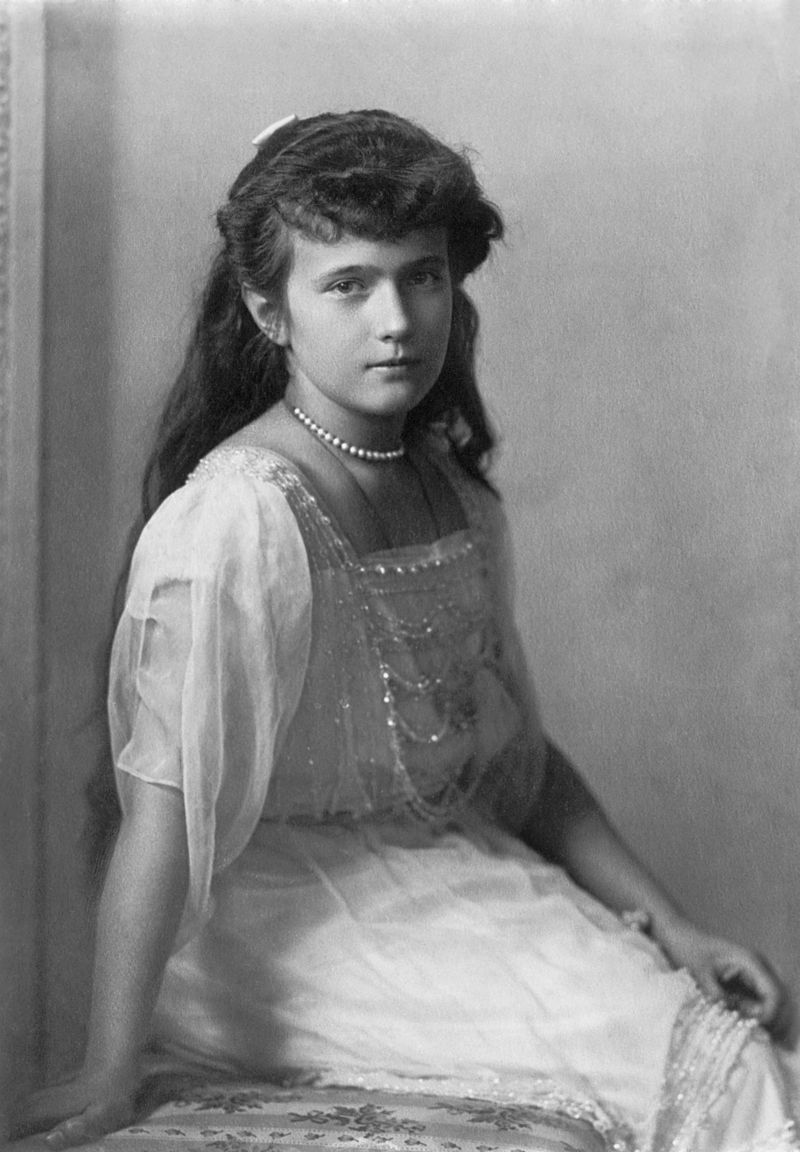
Grand Duchess Anastasia Nikolaevna Romanov of Russia


Grand Duchess Anastasia Nikolaevna of Russia (Russian: Анастасия Николаевна Романова, romanizedAnastasiya Nikolaevna Romanova; 18 June [O.S. 5 June] 1901 – 17 July 1918) was the youngest daughter of Tsar Nicholas II, the last sovereign of Imperial Russia, and his wife, Tsarina Alexandra Feodorovna.

Anastasia was the younger sister of Grand Duchesses Olga, Tatiana, and Maria, and was the elder sister of Alexei Nikolaevich, Tsarevich of Russia. She was killed with her family by a group of Bolsheviks in Yekaterinburg on 17 July 1918.[1]

Persistent rumors of her possible escape circulated after her death, fueled by the fact that the location of her burial was unknown during the decades of Communist rule. The abandoned mine serving as a mass grave near Yekaterinburg which held the acidified remains of the Tsar, his wife, and three of their daughters was revealed in 1991. These remains were put to rest at Peter and Paul Fortress in 1998. The bodies of Alexei Nikolaevich and the remaining daughter—either Anastasia or her older sister Maria—were discovered in 2007. Her purported survival has been conclusively disproven. Scientific analysis including DNA testing confirmed that the remains are those of the imperial family, showing that all four grand duchesses were killed in 1918.[2][3]

Several women falsely claimed to have been Anastasia; the best known impostor was Anna Anderson. Anderson's body was cremated upon her death in 1984, but DNA testing in 1994 on available pieces of Anderson's tissue and hair showed no relation to the Romanov family.

Association with Grigori Rasputin

Grand Duchess Anastasia with her mother, Tsarina Alexandra, in about 1908

Her mother relied on the counsel of Grigori Rasputin, a Russian peasant and wandering starets or "holy man," and credited his prayers with saving the ailing Tsarevich on numerous occasions. Anastasia and her siblings were taught to view Rasputin as "Our Friend" and to share confidences with him. In the autumn of 1907, Anastasia's aunt Grand Duchess Olga Alexandrovna of Russia was escorted to the nursery by the Tsar to meet Rasputin. Anastasia, her sisters and brother Alexei were all wearing their long white nightgowns. "All the children seemed to like him," Olga Alexandrovna recalled. "They were completely at ease with him."[29] Rasputin's friendship with the imperial children was evident in some of the messages he sent to them. In February 1909, Rasputin sent the imperial children a telegram, advising them to "Love the whole of God's nature, the whole of His creation in particular this earth. The Mother of God was always occupied with flowers and needlework."[30]

However, one of the girls' governesses, Sofia Ivanovna Tyutcheva, was horrified in 1910 that Rasputin was permitted access to the nursery when the four girls were in their nightgowns and wanted him barred. Nicholas asked Rasputin to avoid going to the nurseries in the future. The children were aware of the tension and feared that their mother would be angered by Tyutcheva's actions. "I am so afr(aid) that S.I. (governess Sofia Ivanovna Tyutcheva) can speak ... about our friend something bad," Anastasia's twelve-year-old sister Tatiana wrote to their mother on 8 March 1910. "I hope our nurse will be nice to our friend now."[31]

Grand Duchess Anastasia with her brother Alexei
Grand Duchess Anastasia in court dress in 1910

Tyutcheva was eventually fired. She took her story to other members of the family.[32] While Rasputin's visits to the children were, by all accounts, completely innocent in nature, the family was scandalized. Tyutcheva told Nicholas's sister, Grand Duchess Xenia Alexandrovna of Russia, that Rasputin visited the girls, talked with them while they were getting ready for bed, and hugged and patted them. Tyutcheva said the children had been taught not to discuss Rasputin with her and were careful to hide his visits from the nursery staff. Xenia wrote on 15 March 1910, that she couldn't understand "...the attitude of Alix and the children to that sinister Grigory (whom they consider to be almost a saint, when in fact he's only a khlyst!)"[31]

In the spring of 1910, Maria Ivanovna Vishnyakova, a royal governess, claimed that Rasputin had raped her. Vishnyakova said the empress refused to believe her account of the assault, and insisted that "everything Rasputin does is holy."[33] Grand Duchess Olga Alexandrovna was told that Vishnyakova's claim had been immediately investigated, but instead "they caught the young woman in bed with a Cossack of the Imperial Guard." Vishnyakova was kept from seeing Rasputin after she made her accusation and was eventually dismissed from her post in 1913.[34]

However, rumors persisted and it was later whispered in society that Rasputin had seduced not only the Tsarina but also the four grand duchesses.[35] This was followed by circulation of pornographic cartoons, which depicted Rasputin having relations with the Empress, her four daughters and Anna Vyrubova.[36] After the scandal, Nicholas ordered Rasputin to leave St. Petersburg for a time, much to Alexandra's displeasure, and Rasputin went on a pilgrimage to Palestine.[37] Despite the rumors, the imperial family's association with Rasputin continued until his murder on 17 December 1916. "Our Friend is so contented with our girlies, says they have gone through heavy 'courses' for their age and their souls have much developed", Alexandra wrote to Nicholas on 6 December 1916.[38]

In his memoirs, A. A. Mordvinov reported that the four grand duchesses appeared "cold and visibly terribly upset" by Rasputin's death, and sat "huddled up closely together" on a sofa in one of their bedrooms on the night they received the news. Mordvinov recalled that the young women were in a gloomy mood and seemed to sense the political upheaval that was about to be unleashed.[39] Rasputin was buried with an icon signed on its reverse by Anastasia, her mother and her sisters. She attended his funeral on 21 December 1916, and her family planned to build a church over the site of Rasputin's grave.[40] After they were killed by the Bolsheviks, it was discovered Anastasia and her sisters were all wearing amulets bearing Rasputin's picture and a prayer.


Czar Alexander II of Russia--Seward's Folly


Alexander II (Russian: Алекса́ндр II Никола́евич, tr. Aleksándr II Nikoláyevich, IPA: [ɐlʲɪˈksandr ftɐˈroj nʲɪkɐˈlajɪvʲɪtɕ]; 29 April 1818 – 13 March 1881)[a] was Emperor of Russia, King of Congress Poland and Grand Duke of Finland from 2 March 1855 until his assassination.[1]

Alexander's most significant reform as emperor was the emancipation of Russia's serfs in 1861, for which he is known as Alexander the Liberator (Russian: Алекса́ндр Освободи́тель, tr. Aleksándr Osvobodytel, IPA: [ɐlʲɪˈksandr ɐsvəbɐˈdʲitʲɪlʲ]). The tsar was responsible for other reforms, including reorganizing the judicial system, setting up elected local judges, abolishing corporal punishment,[2] promoting local self-government through the zemstvo system, imposing universal military service, ending some privileges of the nobility, and promoting university education. After an assassination attempt in 1866, Alexander adopted a somewhat more reactionary stance until his death.[3]

Alexander pivoted towards foreign policy and sold Alaska to the United States in 1867, fearing the remote colony would fall into British hands if there were another war.[4] He sought peace, moved away from bellicose France when Napoleon III fell in 1871, and in 1872 joined with Germany and Austria in the League of the Three Emperors that stabilized the European situation. Despite his otherwise pacifist foreign policy, he fought a brief war with the Ottoman Empire in 1877–78, leading to the independence of the Bulgarian, Montenegrin, Romanian and Serbian states, pursued further expansion into Far East and the Caucasus, and conquered Turkestan, also approving plans leading to the Circassian genocide.[5] Although disappointed by the results of the Congress of Berlin in 1878, Alexander abided by that agreement. Among his greatest domestic challenges was an uprising in Poland in 1863, to which he responded by stripping that land of its separate constitution and incorporating it directly into Russia. Alexander was proposing additional parliamentary reforms to counter the rise of nascent revolutionary and anarchistic movements when he was assassinated in 1881.


www.flickr.com
Doc Rock's photos More of Doc Rock's photos

Iraq War Costs--Going Up!!!!

Cost of the War in Iraq
(JavaScript Error)